Sunday, 12 July 2020

Equity Value vs Enterprise Value

Difference Between Equity and Enterprise Value 

The equity value of the company is of two types: market equity value which is the total number of shares multiplied by market share price and the book equity which is the value of assets minus liabilities; whereas, enterprise value is the total value of equity plus debt minus the total amount of cash the company has– this roughly gives an idea about the total obligation a company has.

This is one of the most common valuation topics that cause confusion in Equity Research and Investment Banking. In most basic terms, Equity Value is the value only to the shareholders, however, Enterprise value is the value of the firm that accrues to both the shareholders and the debt holders (combined).

What is Equity Value?

Equity value is simply the value of a firm’s equity i.e. the market capitalization of the firm. It can be calculated by multiplying the market value per share by the total number of shares outstanding.
For example, let’s assume Company A has the following characteristics:

Enterprise Value Vs Equity Value - Example 1
Based on the formula above, you can calculate Company A’s equity value as follows:
  • = $1,000,000 x 50
  • =  $50,000,000
However, in most cases, this is not an accurate reflection of a company’s true value.

What is Enterprise Value?

Enterprise value considers much more than just the value of a company’s outstanding equity. It tells you how much a business is worth. Enterprise value is the theoretical price an acquirer might pay for another firm, and is useful in comparing firms with different capital structures since the value of a firm is unaffected by its choice of capital structure. To buy a company outright, an acquirer would have to assume the acquired company’s debt, though it would also receive all of the acquired company’s cash. Acquiring the debt increases the cost to buy the company, but acquiring the cash reduces the cost of acquiring the company.


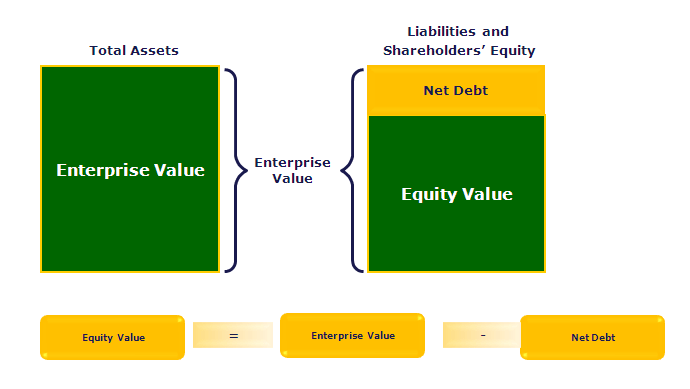
  • Enterprise Value  =  Market value of operating assets
  • Equity Value = Market value of shareholders’ equity
Net Debt – Net debt is equal to total debt less cash and cash equivalents.

Equity Value vs Enterprise Value 

What is Equity Value Multiple?

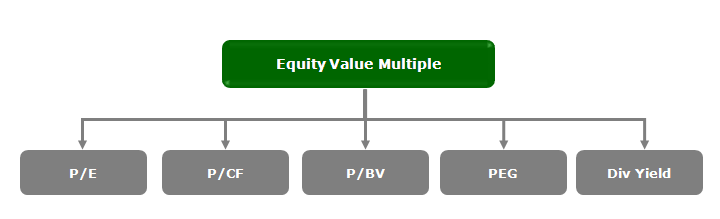
The equity value multiples have both the numerator and the denominator as the “Equity” measure. Some of the multiples of Equity value multiples are as per below.
Equity Value Multiple
Numerator – Equity Value is Price per share that shareholders are expected to pay for a single share of the company under consideration
Denominator – Operating parameters like EPS, CFS, BV, etc equity measures. For example EPS – Earnings per share and it reflects the profit per share that accrues to the shareholders.
  • PE Multiple – This ‘headline’ ratio is, in essence, a payback calculation: it states how many years’ earnings it will take for the investor to recover the price paid for the shares. Other things being equal when comparing the price of two stocks in the same sector the investor should prefer the one with the lowest PE.
  • PCF Multiple – It is a measure of the market’s expectations of a firm’s future financial health. This measure deals with cash flow, the effects of depreciation and other non-cash factors are removed.
  • P/BV Multiple – Useful measure where tangible assets are the source of value generation. Because of its close linkage to return on equity (price to book is PE multiplied by ROE), it is useful to view price to book value together with ROE
  • P/S Multiple – Price/sales can be useful when a company is loss-making or its margins are uncharacteristically low (distressed firms)
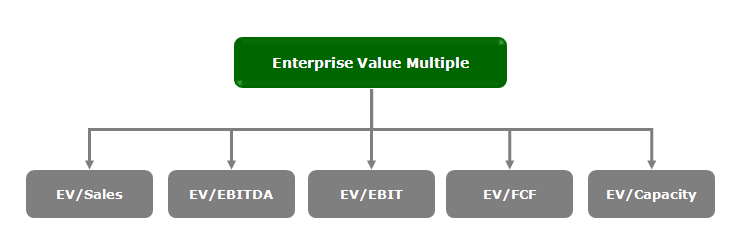
  • PEG Multiple – PEG ratio used to determine stock’s value while taking into account earnings growth. The enterprise value multiples have both the numerator and the denominator as “Pre Debt” and “Pre-Equity” measure. Some of the multiples of Enterprise value multiples are as per below.

What is Enterprise Value or EV Multiples?
Enterprise Value Multiple
Numerator – Enterprise value is primarily a pre-debt and pre-equity measure as EV reflects values both to the Debtors as well as Shareholders’.
Denominator – Operating parameters like Sales, EBITDA, EBIT, FCF, Capacity are pre-debt and pre-equity measures. For example EBITDA – Earnings “before” Interest tax depreciation and amortization; this implies that EBITDA is measure before the debtors and shareholders are paid off and likewise.
  • EV/EBITDA Multiple – Measure that indicates the value of the overall company, not just equity. EV to EBITDA, is a measure of the cost of a stock which is more frequently valid for comparisons across companies than the price to earnings ratio. Like the P/E ratio, the EV / EBITDA ratio is a measure of how expensive a stock is.
  • EV/Sales Multiple – EV/sales is a crude measure, but least susceptible to accounting differences. It is equivalent to its equity counterpart, price to sales, where company has no debt
  • EV/EBIT Multiple – EBIT is a better measure of ‘free’ (post-maintenance capital spending) cash flow than EBITDA and is more comparable where capital intensities differ.
  • EV/FCF Multiple – EV/FCF is preferable to EV/EBITDA for comparing companies within a sector. Comparing across sectors or markets where companies have widely varying degrees of capital intensity
  • EV/Capacity – Core EV/units of capacity (such as tonnes of cement capacity) or another revenue-generating unit (such as subscribers).

Equity vs Enterprise Value Comparative Table

Equity ValueEnterprise Value (EV)
Express the value of shareholders’ claims on the assets and cash flows of the businessCost of buying the right to the whole of an enterprise’s core cash flow
Reflects residual earnings after the payment to creditors, minority shareholders & other non-equity claimantsIncludes all forms of capital – equity, debt, preferred stock, minority interest
Advantages of Equity Value 
• More relevant to equity valuations
• More reliable
• More familiar to investors
Advantages of Enterprise Value   
•Accounting policy differences can be minimized
• Avoid the influence of capital structure
• Comprehensive
• Enables to exclude non-core assets
• Easier to apply to cash flow

Overvalued or Undervalued?

There are primarily two ways in which the fair valuation of the company can be arrived at using the relative valuation technique. They are historical multiple methods and sector multiple methods.

#1 – Historical Multiple Method

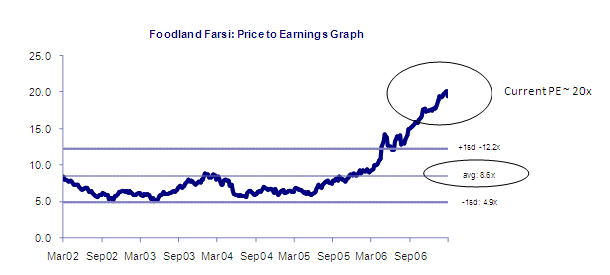
The common approach is to compare the current multiple to a historical multiple measured at a comparable point in the business cycle and macroeconomic environment.
 PE Graph
The interpretations are relatively simpler if we create the Price to Earnings Graph. As noted above, the Foodland Farsi current PE ~ 20x, however, the historical average PE was closer to 8.6x.
Currently, the market is commanding $20/EPS (defined as PE); however, in the past, this stock was trading at $8.6/EPS. This implies that the stock is overvalued with PE = 20x when compared with historical PE = 8.6x and we may recommend SELL position on this stock.

#2 – Sector Multiple Method

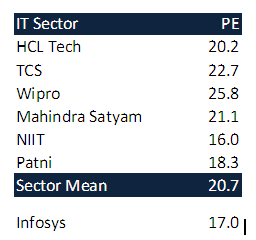
In this approach, we compare current multiples to those of other companies, a sector or a market. Below is a hypothetical example to explain this methodology.
PE Sector Multiple
From the table above, the average PE multiple for the IT sector is 20.7x. However, the company under consideration – Infosys is trading at 17.0x. This implies that Infosys is trading below the average sector multiple and a BUY signal is warranted.

Conclusion

As we note from the above article that both tools are important from the point of view of Valuations. Equity Value is the value only to the shareholders, however, Enterprise value is the value of the firm that accrues to both the shareholders and the debt holders (combined).
In each company/sector, however, there are 3-5 multiples (Enterprise value or Equity value or both) that can be applied. It is more important for you to know the usage and application of each multiple.


Saturday, 11 July 2020

Break-Even Analysis


One a useful tool in tracking your business's cash flow is a break-even analysis. It's a fairly simple calculation and can prove very helpful in deciding whether to make an equipment purchase or in knowing how close you are to your break-even level. Here are the variables needed to compute a break-even sales analysis:
  • Gross profit margin
  • Operating expenses (less depreciation)
  • Annual debt service (total monthly debt payments for the year)
Since we're dealing with cash flow, and depreciation is a non-cash expense, it's subtracted from the operating expenses. The break-even calculation for sales is:
(Operating Expenses + Annual Debt Service)/Gross Profit Margin = Break-Even Sales

Let's use ABC Clothing as an example and compute this company's break-even sales for years one and two. In Year 1, the company's sales were $1 million and their gross profit was $250,000, resulting in a gross profit margin of 25 per cent ($250,000/$1 million). In Year 2, sales were $1.5 million and gross profits were $450,000, resulting in a gross profit margin of 30 per cent (($450,000/$1.5 million). 

Now let's use calculate their break-even sales figure:

Break-Even Sales for Year 1:

(Operating Expenses of $170,000 + Annual Debt Service of $30,000)/Gross Profit Margin of 25 percent (.25) = $800,000 break-even sales figure

Break-Even Sales for Year 2:

(Operating Expenses of $245,000 + Annual Debt Service of $30,000)/Gross Profit Margin of 30 percent (.30) = $916,667 break-even sales figure
It's apparent from these calculations that ABC Clothing was well ahead of break-even sales both in Year 1 ($1 million sales) and Year 2 ($1.5 million sales).

Break-even the analysis also can be used to calculate break-even sales needed for the other variables in the equation. 
Let's say the owner of ABC Clothing was confident he or she could generate sales of $750,000, and the company's operating expenses are $170,000 with $30,000 in annual current maturities of long-term debt. 
The break-even gross margin needed would be calculated as follows:

($170,000 + $30,000)/$750,000 = 26.7%

Now let's use ABC Clothing to determine the break-even operating expenses. If we know the gross margin is 25 per cent, the sales are $750,000 and the current maturities of long-term debt are $30,000, we can calculate the break-even operating expenses as follows:

(.25 x $750,000) - $30,000 = $157,500

Debt vs. equity: आपके स्टार्टअप के लिए कौन सा सही है?

It takes money to make money. Deciding where to find the first funds to get a startup off the ground is one of the most important decisions an entrepreneur has to make.


We Asked 12 startup founders what advice they would give an early-stage entrepreneur who’s considering debt vs. equity. (Share your own thoughts in the comments.)

Consider sweat equity first

When you take on any type of investment from someone else, you’re forfeiting some of your control of the company by default (even if you don’t do equity, you’re still obligated to your creditor). Because you raise capital, ask yourself if you can do this without the investment, especially if the venture is web-based. Chances are, you can. Investment is overrated anyway — customers matter more.
Matthew Ackerson, @petoveradesignPetoVera

Try your best at debt first

I’m a big believer in keeping as much control over your business as possible. Debt — in the forms of lines of credit or loans — is an effective means to build up short-term capital while keeping 100 percent of your business. Having investors with equity shares is like having many bosses, and you risk losing control.

Decide if you’re in this business forever

If this is it — the big idea that you want to work on long-term — debt may be the best option. You need to keep control when something is your baby and you plan to work on it forever. But if you’re looking at building this business and then moving on to something else cool, equity looks like a better option. It means people are already interested in your company and may be willing to buy you out.

Remember, equity is clean

When going through your first round of fundraising, often times you will come across convertible debt notes versus equity. Equity is the cleanest term versus a convertible debt because it is risk capital that doesn’t have to be paid back. With a convertible, you have to pay it back or it gets converted into equity and comes with extra terms. Cost of equity can be higher though because of dilution.
Carmen Benitez, @carmen_benitezFetch Plus

Evaluate your position

There are several factors to consider, although I would suggest that accepting either debt or equity investment is entirely situational. Sometimes you won’t have a choice, frankly. You should look for strategic investors that have access to more capital, more investors, and industry-specific connections. I would also hire an attorney with expertise in structuring investment deals.

Be thankful you have a choice

At the end of the day, when you need money for that next big step and you have found someone willing to fund you, your say in the matter is rather limited. Remember the golden rule for startups — he who has the gold often makes the rules.

There’s no single right answer

Each option has its pros and cons. It’s crucial to evaluate both the debt and equity options, get formal terms for each, then decide which makes more sense for the future growth of the business.
Josh Weiss, @bluegalaBluegala

Avoid debt if possible

A startup’s break-even point is one of the most important, yet often neglected measurements. If a company can become profitable early on through hard work and niche market penetration, a certain type of momentum is garnered — that is indescribable. Going into debt, on the other hand, forces the entrepreneur to always be looking backwards at the lenders waiting to be paid back.
Logan Lenz, @loganlenzEndagon.com

It depends on the terms

Debt vs. equity depends on the terms. If it’s unsecured debt and even close to near-market rates, the deal would seem pretty attractive.
Brent Beshore, @BrentBeshoreAdVentures

Share equity for less risk

We bootstrapped for the first 18 months before finally taking on a few equity investors. We generate a lot of sales, so debt is a great option (we can use the cash from the sale to pay it down). However, I made a personal decision that I had taken on enough risk in investing my time and money into my company. Instead of adding more debt (and personal guarantees), I decided to share the upside!
Aaron Schwartz, @ModifyWatchesModify Watches

Make a big, big pie

Many early-stage entrepreneurs worry about losing control of their business when taking on an equity investment, but issuing equity can help your company get to the next level. The right investors aren’t bosses, they’re partners who are incentivized to help you succeed. They’ll make introductions or help you with strategy. It’s better to have a small slice of a big pie than all of nothing!
Bhavin Parikh, @bkparikhMagoosh Test Prep

Do What’s Best for Your Business

The right method to finance the next phase of your company should come down to the kind of business you’re in. We used convertible debt early on (via an accelerator), but there are plenty of early businesses in which that might not make sense. Ask other entrepreneurs for advice (and mentors, if you have them). This kind of decision is very non-general; make the decision that’s best for your team.

Derek Shanahan, @dshanahanFoodtree

Thursday, 9 July 2020

Debt and Equity Financing


When it comes to getting outside funding for your startup.


Need some practical advice about whether you should use debt or equity financing during the startup stage? Here are a few tips to help you choose the best source for your business.

When it comes to the financing popularity contest, equity funding is currently in vogue. Articles in the mainstream media about venture capital have glamorized the concept of selling stock in your startup, and entrepreneurs across the board would much prefer to raise money in the form of equity rather than debt.

Why is equity so appealing? Because it feels like you're getting "free" money during the startup stage. There are usually no repayment obligations and no interest payments due to equity investors. You'll also have some say in negotiating the price of your stock, any dividend payments and the position the investor will have in your company. If your business goes belly-up, it's their loss (unless, of course, your investors can prove in court that you didn't disclose critical information that would have influenced their decision to invest).

Besides providing funding, equity investors can be helpful in other ways as well. They bring their business experience and lessons learned to bear on your company, and they can become a trusted advisor, mentor or board member. The best equity investors are those with expertise in your industry, experience launching a business, a cool temperament and deep pockets. Some say choosing an equity investor is like getting married--you're making yourself accountable to this person through thick and thin, so choose carefully.

Before you go investor shopping, though, you should carefully think about just what you're selling and what having equity investors really means for you and your business. Very few businesses will ever be able to deliver a decent return on investment (ROI) for equity investors. The typical restaurant or retail store, for example, is unlikely to have any liquidity for its shares. And even if you plan to have a high-growth tech business, the chance of reaching liquidity for your early investors is low. You must be honest with yourself about whether your investors expect to be paid back.
Assuming you won't have a glamorous initial public offering, you'll need to find a way to allow your investors a graceful exit. One option is to find a new wave of investors willing to buy out the old ones at a share price that feels like a win-win for all. Another option for investors--especially friends and family who want to stay involved--is to convert equity positions into loans. In my role as president of CircleLending, I've encountered these loan conversions quite frequently, even though equity investors typically have no legal recourse in the event the business fails. This is one of the hidden secrets of startup financing--that equity investments from relatives, friends and other startup investors often morph into loans if the businesses fail.

But what about good, old-fashioned loans? If the sheen of equity capital is tarnished by the reality of having to generate a respectable ROI, you can fall back on the old familiar friend: a loan. The good news about debt financing is that you're still completely in charge of your business--your only duty to your lender is to make your payments on time, as spelt out in your promissory note. As long as you do that, your lender has no right to meddle in your business. Interest payments are typically a deductible business expense, and if your lender is someone you know well, you may be able to get favourable repayment terms that can make the loan walk and talk much like an equity investment.

There are several ways to create this flexibility:

  • Defer the start date of repayment by adding a "grace period." Startup loans often have a six- to 12-month grace period before repayment starts, providing entrepreneurs with some time to ramp up the business.
  • Capitalize interest. Your lender can also capitalize the deferred payments so they don't lose interest funds during the grace period. This allows you to pitch a lender by suggesting a much longer grace period (if you think you'll need more than 12 months).
  • Use interest-only payments. If your lender wants to be repaid immediately, offer to make interest-only payments for a period of time to keep your monthly budget in check.
  • Institute graduated payments. You can create a unique repayment schedule with low payments at the start of the loan and higher payments at the end when your business is proven.


Financial Management


A good financial management system tells you how your business is doing--and why.

While a well-organized bookkeeping system is vital, even more, critical is what you do with it to establish your methods for financial management and control. Think of your bookkeeping system as the body of a car. 

A car body can be engineered, painted and finished to look sleek and powerful. However, the car body won't get anywhere without an engine. Your financial management system is the engine that will make your car achieve peak performance.

You maybe wondering what exactly is meant by the term "financial management." 

It is the process you use to put your numbers to work to make your business more successful. With a good financial management system, you will know not only how your business is doing financially, but why. And you will be able to use it to make decisions to improve the operation of your business.

Why is financial management important? 

Because a good financial management system enables you to accomplish an important big picture and daily financial objectives. 

A good financial management system helps you become a better macro manager by enabling you to:

1. Manage proactively rather than reactively.

2. Borrow money more easily; not only can you plan ahead for financing needs, but sharing your budget with your banker will help in the loan approval process.

3. Provide financial planning information for investors.

4. Make your operation more profitable and efficient.

5. Access a great decision-making tool for key financial considerations.

Financial planning and control help you become a better micromanager by enabling you to:

1. Avoid investing too much money in fixed assets.

2. Maintain short-term working capital needs to support accounts receivable and inventory more efficiently.

3. Set sales goals; you need to be growth-oriented, not just an "order taker."

4. Improve gross profit margin by pricing your services more effectively or by reducing supplier prices, direct labour, etc., that affect the cost of goods sold.

5. Operate your business more efficiently by keeping selling and general and administrative expenses down more effectively.

6. Perform tax planning.

7. Plan ahead for employee benefits.

8. Perform a sensitivity analysis with the different financial variables involved.

The first step in developing a financial management system is the creation of financial statements. To manage proactively, you should plan to generate financial statements on a monthly basis. 
Your financial statements should include an income statement, a balance sheet and a cash flow statement.

A good automated accounting software package will create the monthly financial statements for you. If your bookkeeping system is manual, you still can use an internal or external bookkeeper to provide you with monthly financial statements.